
FGV 2024.1Questão 32de 60According to the information in the article, Catherine Tylan and her colleagues most likely believe that
InglêsInterpretação de texto
Texto das questões 31 a 34
Texto para as perguntas de 31 a 34
EATING FOR IMMUNITY
By
Brittany Steff
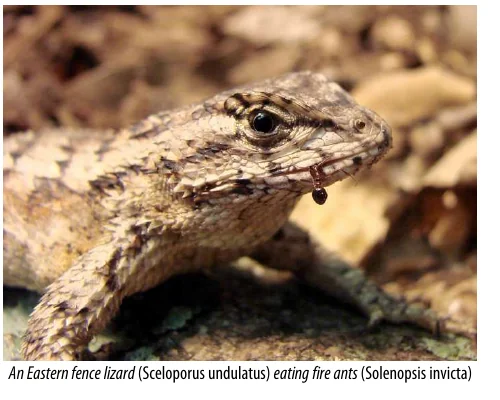
1 Eastern fence lizards live in dry pine forests, around houses and barns, and, as their name implies, along fences in most of the eastern states south of the Ohio River Valley [na fronteira do meio-oeste e sul dos EUA]. Their colors and patterning mimic wood and bark [casca de árvore], enabling them to hide from birds, their primary predators. But fire ants from South America are slowly moving northward in the United States and posing [representando] a new threat to the lizards, which are a source of food.
2 Ecologist Tracy Langkilde and colleagues in her laboratory at Pennsylvania State University have long studied fence lizard ecosystems and have found that the way fence lizards – individuals and populations – are responding to this new threat offers a fascinating look into a species’ response to rapid environmental change.
3 “The fire ants attack the lizards,” said Catherine Tylan, the study’s lead author. “Where the fire ants live, fence lizards have shorter lifespans, and rougher lives. They have had to change how they react behaviorally to [this new] predator…their limbs have even changed to be longer so they can run faster.”
4 The research shows that, in areas rife [cheias] with fire ants, lizards have changed other defensive strategies. Rather than freezing to camouflage, they now thrash [mexem vigorosamente] their bodies and twitch [estremecem] their limbs before fleeing, much as a human would when attacked by a fire ant. And the lizards have started eating the ants.
5 Consuming fire ants, of course, eliminates those individuals from threatening again. But the research also indicates that eating fire ants stimulates lizard immune systems, making them more resistant to bites in the future. Tylan explained, “We see very clear differences in immune profiles between communities where the fire ants are present and where they’re absent. By eating the fire ants, the lizards may be helping themselves immunologically to defend against stings.”
Adapted from Natural History, Dec.2022 – Jan.2023.
According to the information in the article, Catherine Tylan and her colleagues most likely believe that
- Alternativa A: fire ants do not release venom when they are being eaten by eastern fence lizards.
- Alternativa B, a correta: fire ant aggression has stimulated anatomical changes in some groups of eastern fence lizards.Resposta
- Alternativa C: one great problem for eastern fence lizards is that fire ants are especially attracted to dry pine forests as a habitat.
- Alternativa D: the defensive strategies that protect eastern fence lizards from birds attract the attention of fire ants.
- Alternativa E: a fire ant attack that does not kill an eastern fence lizard will leave it permanently weakened.
A questão pergunta no que Catherine Tylan e seus colegas provavelmente acreditam, segundo o artigo.
Localizando a fala dela no texto:
No parágrafo 3, Tylan afirma: "Where the fire ants live, fence lizards have shorter lifespans, and rougher lives. They have had to change how they react behaviorally to [this new] predator… their limbs have even changed to be longer so they can run faster."
Interpretando o trecho:
Membros mais longos são uma mudança ANATÔMICA, não de comportamento, e ela ocorreu onde as formigas estão presentes, em resposta à pressão que elas exercem. É exatamente o que a alternativa correta afirma: a agressão das formigas estimulou mudanças anatômicas em alguns grupos de lagartos.
Analisando as demais alternativas:
A alternativa sobre as formigas não liberarem veneno ao serem comidas contraria o parágrafo 5, que fala em resistência a picadas.
A alternativa sobre as formigas serem atraídas por florestas secas de pinheiro não tem apoio: o texto diz que as formigas avançam para o norte, sem falar em preferência de habitat.
A alternativa que diz que as estratégias de defesa contra pássaros atraem as formigas inverte o texto: a camuflagem protege dos pássaros, e o texto não diz que ela atrai formigas.
A alternativa sobre o lagarto ficar permanentemente enfraquecido contradiz o parágrafo 5, que fala em ficar MAIS resistente.
Conferindo a alternativa:
A afirmação sobre mudanças anatômicas corresponde à alternativa B.
Confere com o gabarito oficial da FGV. Ver o caderno da banca