
FGV 2025.2Questão 38de 60The information in the article most likely suggests which of the following?
InglêsInterpretação de texto
Numeração da prova tipo 1.
Texto das questões 37 e 38
TOO CLOSE FOR COMFORT By Kati Moore
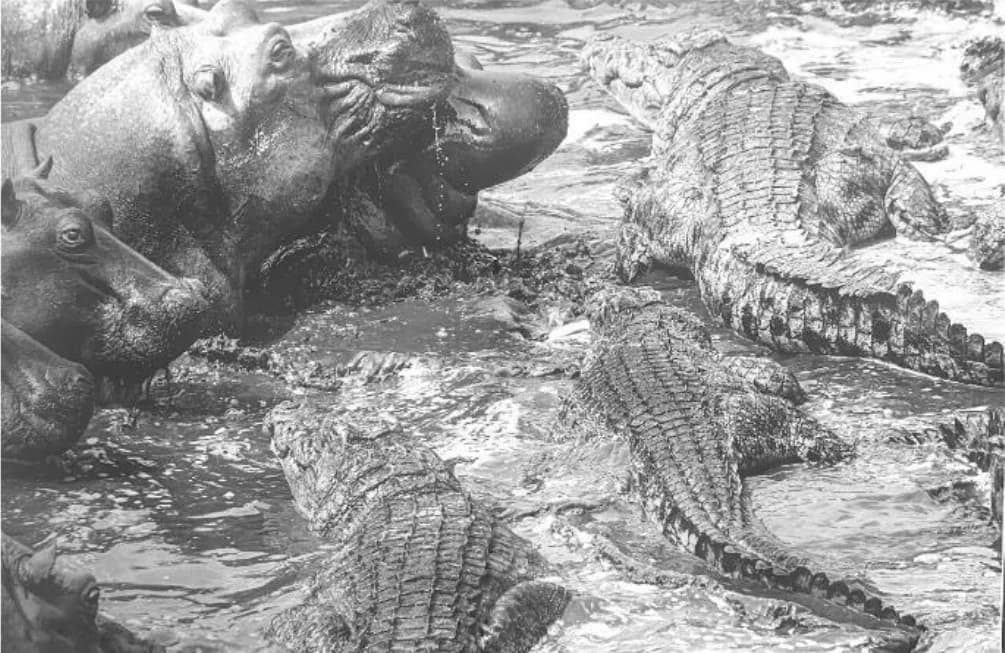
(Photograph By Art Wolfe)
When the dry season comes to Katavi National Park in Tanzania, the Ikuu River starts to shrink to a series of disconnected pools along the river bed. Hippos (Hippopotamus amphibius), lacking sweat glands, congregate by the hundreds in these pools to stay cool. Photographer Art Wolfe was visiting the park toward the end of the dry season to photograph an eclipse when he came across this scene. In a semi-arid acacia forest, about a hundred hippos crowded into a pool roughly fifty yards [cerca de 46 metros] long and twenty-five yards [cerca de 23 metros] wide. About a half mile down river there was another pool of a hundred or so hippos. A group of Nile crocodiles (Crocodylus niloticus) moving downstream encountered the hippos. Though crocodiles mainly eat fish, they will sometimes attack other prey [presa], including small hippos. Hippos, however, can weigh more than 3,000 pounds [1.360 quilos], and adults will fight back. Wolfe watched from his vantage point on a bank [margem] above the pool as one of the passing crocodiles got too close to a hippo, and the hippo took a snap at it [deu um bote nele]. The crocodile managed to escape, though it appeared to be wounded. Hippos and crocodiles usually tend to avoid each other – hippos stick to the water and crocodiles sun themselves on the river banks. “It was just sheer luck that all those imposing creatures were all together in the same pond,” Wolfe said. “It was a dramatic moment.”
Adapted from Natural History, July/August 2022
The information in the article most likely suggests which of the following?
- Alternativa A: Semi-arid acacia forests rarely attract large groups of hippos or Nile crocodiles during the dry season.
- Alternativa B: Art Wolfe was in great personal danger when he photographed the hippos and Nile crocodiles.
- Alternativa C: The special conditions of the dry season encouraged a Nile crocodile to take a chance and attack a hippo.
- Alternativa D, a correta: A fully grown hippo will not necessarily try to escape from a Nile crocodile’s attack.Resposta
- Alternativa E: Their greater speed gives Nile crocodiles a decisive advantage over hippos in a fight.
A questão pede o que o artigo sugere.
O trecho que decide:
"Hippos, however, can weigh more than 3,000 pounds, and adults will fight back" (os hipopótamos, porém, podem pesar mais de 1.360 quilos, e os adultos revidam). O episódio confirma: "one of the passing crocodiles got too close to a hippo, and the hippo took a snap at it" (um dos crocodilos que passavam chegou perto demais de um hipopótamo, e o hipopótamo deu um bote nele). Quem fugiu foi o crocodilo, ferido: "The crocodile managed to escape, though it appeared to be wounded" (o crocodilo conseguiu escapar, embora parecesse ferido).
Conferindo a alternativa:
A alternativa A está incorreta. Ela diz que florestas semiáridas de acácia raramente atraem grandes grupos de hipopótamos ou crocodilos na estação seca. A cena aconteceu justamente numa delas, "in a semi-arid acacia forest" (numa floresta semiárida de acácias), com cerca de cem hipopótamos numa só poça; o texto não diz que isso é raro nesse tipo de floresta.
A alternativa B está incorreta. Ela diz que Art Wolfe correu grande perigo ao fotografar. Ele observava "from his vantage point on a bank above the pool" (do seu ponto de observação numa margem acima da poça); nada indica perigo.
A alternativa C está incorreta, e é a mais tentadora. Ela diz que as condições especiais da estação seca encorajaram um crocodilo a se arriscar e atacar um hipopótamo. No texto, o crocodilo não ataca: ele estava de passagem ("passing"), chegou perto demais ("got too close") e quem atacou foi o hipopótamo ("the hippo took a snap at it"). O texto também não liga a estação seca a nenhuma ousadia do crocodilo.
A alternativa D está correta. Ela diz que um hipopótamo adulto não necessariamente tenta fugir do ataque de um crocodilo. Se "adults will fight back" (os adultos revidam), o adulto pode enfrentar em vez de fugir, e foi isso o que aconteceu.
A alternativa E está incorreta. Ela diz que a maior velocidade dá ao crocodilo uma vantagem decisiva numa briga com o hipopótamo. O texto não fala de velocidade, e no episódio o crocodilo saiu ferido.
A ideia de que o hipopótamo adulto pode enfrentar o crocodilo em vez de fugir corresponde à alternativa D.
Confere com o gabarito oficial preliminar da FGV. Ver o caderno da banca