
FGV 2025.2Questão 37de 60The passage supplies information that would most likely answer the following question
InglêsInterpretação de texto
Numeração da prova tipo 1.
Texto das questões 37 e 38
TOO CLOSE FOR COMFORT By Kati Moore
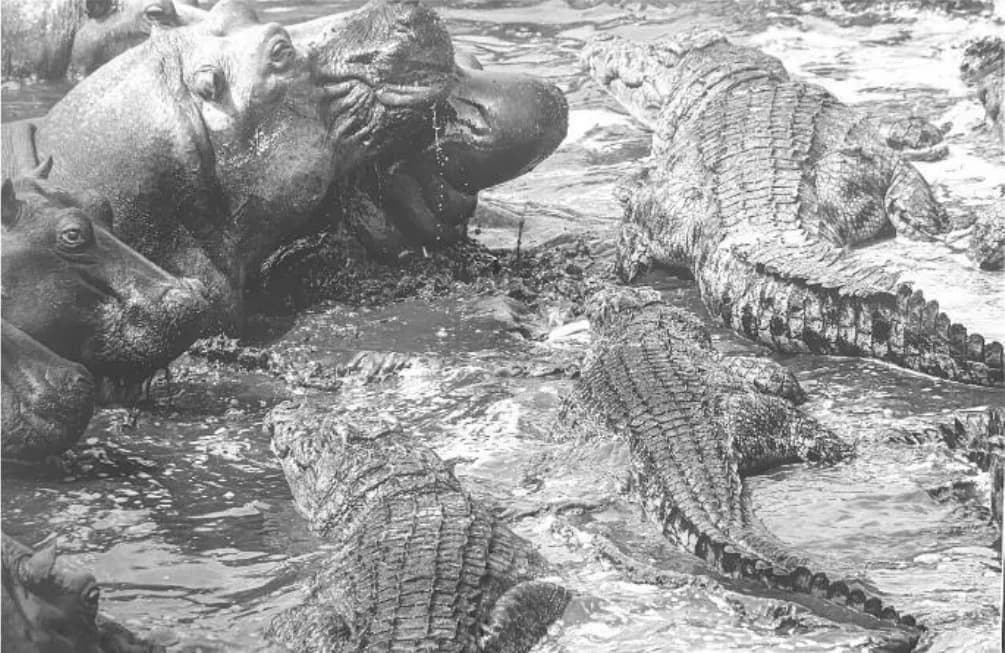
(Photograph By Art Wolfe)
When the dry season comes to Katavi National Park in Tanzania, the Ikuu River starts to shrink to a series of disconnected pools along the river bed. Hippos (Hippopotamus amphibius), lacking sweat glands, congregate by the hundreds in these pools to stay cool. Photographer Art Wolfe was visiting the park toward the end of the dry season to photograph an eclipse when he came across this scene. In a semi-arid acacia forest, about a hundred hippos crowded into a pool roughly fifty yards [cerca de 46 metros] long and twenty-five yards [cerca de 23 metros] wide. About a half mile down river there was another pool of a hundred or so hippos. A group of Nile crocodiles (Crocodylus niloticus) moving downstream encountered the hippos. Though crocodiles mainly eat fish, they will sometimes attack other prey [presa], including small hippos. Hippos, however, can weigh more than 3,000 pounds [1.360 quilos], and adults will fight back. Wolfe watched from his vantage point on a bank [margem] above the pool as one of the passing crocodiles got too close to a hippo, and the hippo took a snap at it [deu um bote nele]. The crocodile managed to escape, though it appeared to be wounded. Hippos and crocodiles usually tend to avoid each other – hippos stick to the water and crocodiles sun themselves on the river banks. “It was just sheer luck that all those imposing creatures were all together in the same pond,” Wolfe said. “It was a dramatic moment.”
Adapted from Natural History, July/August 2022
The passage supplies information that would most likely answer the following question:
- Alternativa A, a correta: What is one biological reason that hippos congregate in pools of water in Katavi National Park during the dry season?Resposta
- Alternativa B: Why does the hippo population in Katavi National Park increase during the dry season?
- Alternativa C: During which months of the year are Nile crocodiles especially attracted to the Ikuu River?
- Alternativa D: Why do hippos always congregate in separate groups of more or less 100 during the dry season in Katavi National Park?
- Alternativa E: Why are Nile crocodiles more likely to attack baby hippos during the dry season than during other times of the year in Katavi National Park?
A questão pede qual pergunta o texto consegue responder.
O trecho que decide:
Logo no primeiro parágrafo: "Hippos (Hippopotamus amphibius), lacking sweat glands, congregate by the hundreds in these pools to stay cool" (os hipopótamos, que não têm glândulas sudoríparas, se reúnem às centenas nessas poças para se manter frescos). Há uma causa biológica (não suar) e uma consequência (buscar a água para se refrescar).
Conferindo a alternativa:
A alternativa A está correta. A pergunta é: qual é uma razão biológica para os hipopótamos se reunirem nas poças do Parque Katavi na estação seca? O texto responde: sem glândulas sudoríparas, eles precisam da água para se refrescar.
A alternativa B está incorreta. A pergunta é: por que a população de hipopótamos do parque aumenta na estação seca? O texto não diz que a população aumenta; diz que o rio encolhe ("starts to shrink to a series of disconnected pools", começa a encolher até virar uma série de poças separadas) e os animais se concentram nelas.
A alternativa C está incorreta. A pergunta é: em que meses do ano os crocodilos-do-nilo são especialmente atraídos pelo rio Ikuu? O texto não cita meses nem diz que os crocodilos são atraídos pelo rio; eles apenas passavam, "moving downstream" (descendo o rio).
A alternativa D está incorreta. A pergunta é: por que os hipopótamos sempre se reúnem em grupos separados de mais ou menos cem na estação seca? O texto descreve duas poças com cerca de cem animais cada ("a hundred or so hippos", uns cem hipopótamos) naquela ocasião, mas não diz que é sempre assim nem explica o número.
A alternativa E está incorreta. A pergunta é: por que os crocodilos atacam mais filhotes de hipopótamo na estação seca do que em outras épocas? O texto diz que crocodilos às vezes atacam "small hippos" (hipopótamos pequenos), mas não compara a estação seca com o resto do ano.
A pergunta sobre a razão biológica para os hipopótamos se reunirem nas poças corresponde à alternativa A.
Confere com o gabarito oficial preliminar da FGV. Ver o caderno da banca